










Sports betting is a fascinating topic among cricket, football, tennis and basketball fans. To fully understand the aspect of sports betting, however, one ought to have knowledge of the betting market, decimal odds, implied odds and settlements.
It is also essential to be aware of some possible financial implications, risks of online betting and applicable legislation before using any online betting services.
This guide offers explanations of the most popular sports betting markets and discusses how betting odds function as well as some important aspects of online safety and Indian gaming legislation.
What Is Sports Betting?
Sports betting offers a chance to win money by betting on the result of a sporting activity and receiving a payout for an accurate guess.
- Predicting the winner of a soccer game
- Betting on whether the cricket team will score a certain number of runs
- Predicting the amount of goals scored in a game
That said, the options depend on different betting markets. In the result market of a soccer match, the options are either a home win, a draw, or an away win.
How Do Sports Betting Markets Work?
A sports betting market is a collection of possible outcomes associated with a sporting event. Each outcome has a quoted price, commonly expressed through odds.
Three important terms explain how these markets work:
- Odds: Figures representing potential total returns and implied probability.
- Stake: The amount of money placed on a prediction, where legally permitted.
- Settlement: The process of determining the result according to published market rules.
For example, a football market may offer three outcomes: home win, draw and away win. Settlement conditions may also specify whether extra time, abandoned matches or player withdrawals are included.
Common Types of Sports Betting Markets
1. Match Result Markets
These markets focus on the outcome of a sporting event. Football generally includes home win, draw and away win, while tennis usually has two possible outcomes: a winning player and a losing player.
2. Over and Under Markets
These markets focus on whether a particular statistic will be above or below a specified number.
For example, a football match with a total-goals line of 2.5 means:
- Over 2.5: At least three goals.
- Under 2.5: Two goals or fewer.
Similar concepts apply to cricket runs and basketball points.
3. Handicap Markets
Handicap markets adjust the starting position of a team or player when calculating an outcome. Common formats include Asian and European handicaps, which have different settlement conditions.
4. Player Performance Markets
These markets focus on individual performances, such as a footballer scoring a goal, a cricket batter reaching a specified number of runs or a tennis player recording a certain number of aces.
Player availability, injuries and playing time can affect settlement.
5. Live Sports Markets
Live Market Betting refers to the betting on events that are happening at that moment and the odds keep changing in light of events happening, like wickets fallen, goals scored or any occurrence that can change the situation before finishing of the match.
These types of betting markets are changing very quickly, thus it is very important to understand the risks associated with betting on such markets.
Understanding Sports Betting Odds
Decimal odds show how much one may earn per unit of the hypothetical money. The decimal odds are quite popular as making calculations with decimal odds is very easy.
How Do Decimal Odds Work?
Consider these mathematical examples:
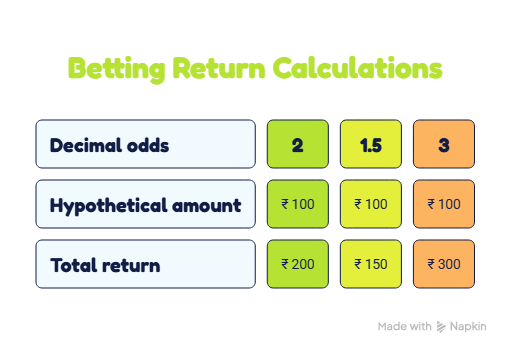
The total return includes the original amount.
Total Return = Amount × Decimal Odds
Net Profit = Total Return − Original Amount
For example, odds of 2.00 multiplied by a hypothetical ₹100 amount produce a total return of ₹200.
These examples are mathematical illustrations, not recommendations to participate in betting.
What Is Implied Probability?
Implied probability is the probability represented mathematically by quoted odds.
The formula is:
Implied Probability = (1 ÷ Decimal Odds) × 100
Examples:
 However, implied probability does not necessarily represent the actual likelihood of a sporting outcome.
What Is the Bookmaker’s Margin?
The bookmaker’s margin, also known as the overround, is the amount by which the combined implied probabilities of all market outcomes exceed 100%.
Consider this hypothetical football market:
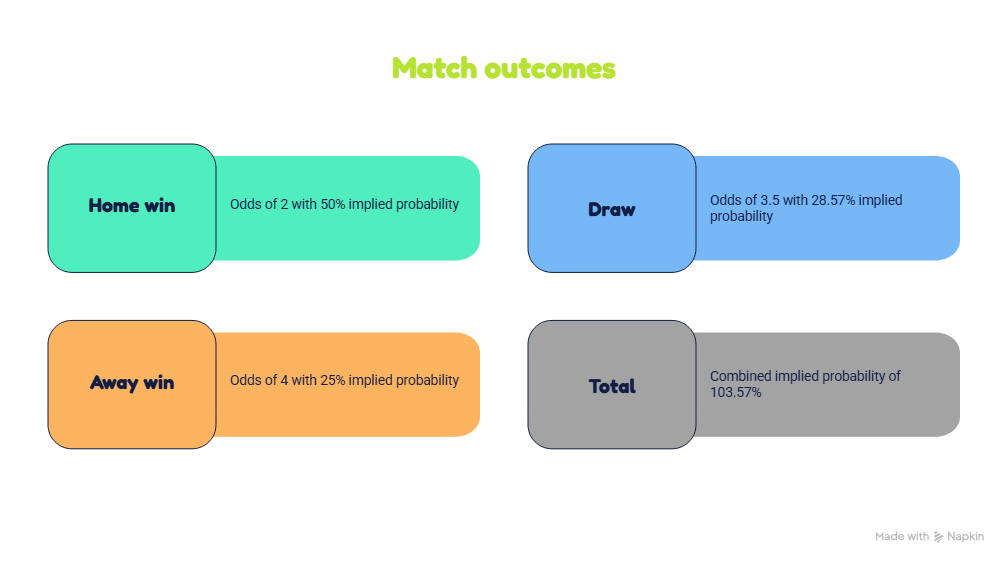
The combined implied probability exceeds 100% by 3.57 percentage points. This difference is known as the overround.
What Influences Sports Betting Odds?
There are several factors that can affect the assessment of sporting events:
- Team and player form: Recent form and historical stats help, but don’t promise.
- Injuries and Team Selection: The lack of players can have an effect on the team’s performance and attitude.
- Venue and conditions of play: Weather, pitch conditions and playing surfaces can all have an impact on the outcome of matches.
- Competition format: Knockout games, extra time and penalties can influence the outcomes.
Despite these factors, sporting events remain unpredictable.
How Are Sports Betting Markets Settled?
Settlement refers to determining an outcome according to the applicable market rules.
Different situations may have different conditions:
- Postponed matches: Markets may remain open or be declared void.
- Abandoned cricket matches: Settlement depends on the competition format and market rules.
- Tennis retirements: Conditions may differ depending on the market and when the player retires.
- Football extra time: A match-result market may cover regular playing time only.
- Player non-participation: Performance markets may have specific participation requirements.
Readers should check the applicable terms rather than assume all markets follow identical settlement procedures.
Risks and Online Safety in Sports Betting
Sports betting involves financial, personal and legal risks. Understanding these risks is important when evaluating online gaming services.
Financial losses: Even predictions based on statistics or historical performance can be incorrect. Sports betting should never be considered a dependable source of income.
Chasing losses: Trying to recover previous losses by continuing to gamble can create further financial difficulties.
Misleading promises: Be cautious of websites claiming to offer guaranteed wins, risk-free strategies or certain predictions. No method can guarantee sporting outcomes.
Online security: Untrustworthy websites can expose users to payment fraud, identity theft and misuse of personal information.
Important online safety practices include:
- Avoid suspicious links and applications from unknown sources.
- Never share passwords, banking credentials or one-time passwords.
- Use strong and unique passwords.
- Check website addresses before sharing personal information.
- Be cautious of unsolicited messages promising guaranteed returns.
If gambling becomes difficult to control, seeking professional help and support is important.
Legal Status of Online Sports Betting in India
Indian online gaming rules cover central laws, state regulations, and pertinent court rulings.
On August 22, 2025, the President approved the Promotion and Regulation of Online Gaming Act, 2025, which went into effect on May 1, 2026. The Promotion and Regulation of Online Gaming Rules, 2026 also became effective on the same date.
Whether they call on skill, chance, or a mix of both, the Act forbids internet money games inside its legal definition.
Its pertinent clauses are:
Section 5: Online money games are not allowed.
Section 6: Advertisement of forbidden online money games.
Section 7: Financial dealings connected to banned online money games.
The Rules set guidelines for classifying online games and managing accepted genres.
Relevant Supreme Court Judgment
On 27 May 2026, the Supreme Court delivered its judgment in State of Tamil Nadu v. Junglee Games India Pvt. Ltd.
The judgment addressed state legislative powers concerning online games played for stakes and upheld the relevant challenged provisions in Tamil Nadu and Karnataka.
This judgment is distinct from the constitutional challenge to the central Online Gaming Act, 2025. It should not be interpreted as a blanket nationwide ruling on every form of sports-related activity.
The legal position depends on the nature of the activity, applicable central legislation and relevant state laws. Readers should consult official legislation and qualified legal professionals before using online gaming services.
Official legal resources:
- India Code: https://www.indiacode.nic.in/
- MeitY: https://www.meity.gov.in/
- Press Information Bureau: https://www.pib.gov.in/
- Supreme Court of India: https://www.sci.gov.in/
How to Evaluate Sports Information Responsibly
Sports statistics and match analysis can explain historical trends but cannot guarantee future results.
Readers should:
- Access trustworthy sports media and official tournament websites.
- Check the accuracy and publication dates of statistics.
- Understand market terminology and settlement conditions.
- Avoid guaranteed-win claims and misleading predictions.
- Never gamble with borrowed money or essential living expenses.
- Protect personal and financial information.
- Seek professional support if gambling affects finances or well-being.
Conclusion
Being knowledgeable about sports betting involves knowing the various sporting events, types of markets, decimal odds, implied probability and rules for settling bets.
Statistical figures and results from historically played matches are valuable; however, they are not a predictor of future outcomes. Also, financial, personal, and legal risks of gambling have to be taken into account.
In India, it is necessary to be informed on the Promotion and Regulation of Online Gaming Act of 2025 and its Rules of 2026 and also on other relevant legislation at the federal and state levels.
Fairplay Service is intended to provide educational information regarding sports betting markets, safety of betting online, and law developments in the sphere of online betting in order to provide assistance in making correct decisions.
Frequently Asked Questions (FAQs)
1. What is sports betting?
This is where the bettor will try to determine the outcome of a sporting event, or any particular aspect of the event, including the winner of the match or individual events within the game, like the number of goals scored in a game.
2. How do decimal sports betting odds work?
Total return decimal odds shows what your total return would be. So, if 2. 00 were the odds, you would be paid out a total of 200 on your hypothetical 100 amount (including your original amount).
3. What is implied probability in sports betting?
Implied probability is the likelihood expressed mathematically by the given odds. It is found by dividing 1 by the decimal odds and then multiplying by 100.
4. Can sports statistics guarantee a winning prediction?
No. Data can illustrate movement trends historically but not guarantees as injuries unknowns variable match conditions etc. can cause results to fluctuate.
5. What are the common types of sports betting markets?
Popular types are match-result, over-and-under, handicap, player-performance, and live sport markets. These can have different settlement conditions.