










A cricket match becomes even more interesting if at the end of it, both sides finish with the same number of scores. Throughout the hours-long game, none of the two sides is able to get ahead of the other. Thus, how is the winner determined? The solution could be a Super Over, used in limited-overs cricket matches.
The Super Over provides each side with an additional opportunity to score runs and settle their match. It is a brief yet intense match, in which every delivery counts. Even hitting a boundary or getting out or scoring an extra run can affect the outcome of the game.
Cricket beginners should learn about the Super Over in order to understand the game better. Here is everything you need to know about what the Super Over in cricket is, how it is played, its rules, scoring system and what happens if it ends in a draw as well.
What Is a Super Over in Cricket?
A Super Over is a technique for resolving the tie between two competing teams when, after finishing their innings, they get equal number of runs while playing in a limited-over format and a win is required according to the playing conditions of the competition.
Two teams receive an additional over having six legal deliveries, and the team which manages to score more runs in that over will be declared the winner.
For instance, there are two teams which have scored 165 runs each after completing their innings. It means that the match has ended up in a tie, but they are going to play a Super Over according to the rules of the competition.
In the Super Over,
- Team A makes 14 runs whereas
- Team B makes 15 runs,
Therefore, Team B becomes the winner since it scored one more run than its opponent.
A Super Over differs from a normal innings in that it is much shorter as teams get few deliveries and may lose just two wickets during their batting innings.
Why Is a Super Over Used in Cricket?
The Super Over is employed in order to declare the winner of the game, especially when the rules of competition demand that there must be a winner. It allows both teams to participate in competition for one more time without playing another whole innings.
There are several advantages of employing this procedure in competitions of cricket.
1. This approach will allow to declare the winner
Where there is no possibility to achieve the desired result through the tied match, the Super Over will provide another way to do so.
2. It will keep the competition short
Without organizing another full innings, the teams will have only one over.
3. Both teams get another chance
The procedure will provide both teams an opportunity to play as batter and bowler under equal conditions.
4. The procedure creates an excitement
As there are six legitimate deliveries in a row, all decisions made during the Super Over can affect the results of the competition.
Nevertheless, the Super Over is not used in every cricket match. It depends on the regulations of the tournament or competition.
Understanding cricket match odds is also useful when learning how cricket match odds are presented and interpreted.
How Does a Super Over Work?
There is a set pattern for conducting the Super Over. The match officials conduct the process in accordance with the appropriate playing conditions.
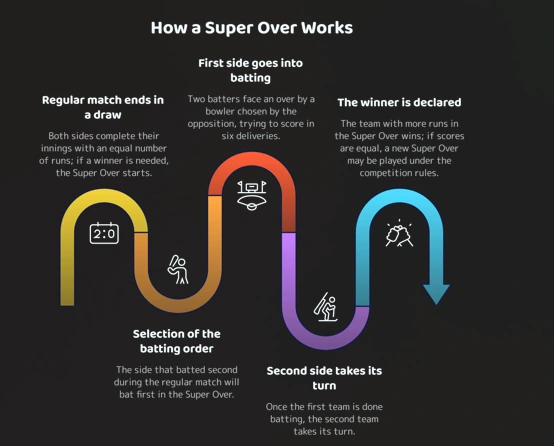
Here is an easy description of how the process is carried out.
Step 1: Regular match ends in a draw
Both sides complete their respective innings having scored an equal number of runs. In case a winner is needed, the Super Over process starts.
Step 2: Selection of the batting order
As per standard ICC international playing conditions, the side which has batted second during the regular match will bat first in the Super Over.
Step 3: First side goes into batting
The batting side sends two batters at the crease to face an over by a bowler chosen by the opposition.
It tries to score as many runs as possible in six deliveries.
Step 4: Second side takes its turn
Once the first team is done with its batting, the second team takes its turn.
Step 5: The winner is declared
The team that gets more runs in the Super Over wins. In case both the teams get the same score in their Super Over, then a new Super Over will be played depending on the rules of the competition.
This way makes the Super Over simple to comprehend for everyone, especially those unfamiliar with cricket.
Super Over Rules Explained
There are certain rules for the Super Over, which differentiate it from an ordinary inning. The following points state some of the basic characteristics of Super Over according to ICC men’s ODI and T20 International playing conditions.
1. One over for each team
Each team is given one over containing six legal balls. The batting inning is completed early if any team loses two wickets.
2. Two wicket restriction
There can be a loss of up to two wickets during the Super Over inning of a team. The moment the second wicket falls, the inning will be terminated.
3. Involvement of three batsmen
Two batsmen would be initially batting at the crease. Once the two batsmen get out, a third batman joins the team to bat, but this is done prior to getting out twice.
4. One bowler for the over
A single bowler for the fielding side bowls his over. It is important to remember here that the bowler should not be from the same bowler who bowls the next Super Over.
5. Fielding restrictions apply
With regard to fielding restrictions, it is similar to the last over of a full game. These help restrict the number of players positioned outside the inner boundary line.
6. Wide ball and no ball delivery
Wide ball and no balls do not count into six deliveries. The bowler instead bowls another delivery, while penalty runs are added to the team’s total score.
7. Selection of bowling end
According to the regulations of the ICC, the end of the pitch is selected by the fielding team from where they will bowl their over.
All these rules make sure that there is fair play.
How Is a Super Over Scored?
Scoring in a Super Over is done as per the regular rules for scoring in a game of cricket. Runs can be scored by both sides in a game through running between the wickets, four runs and six runs, wide, no-ball, and byes and leg-byes.
The following are some of the ways used to score runs:
- Running between the wickets: Runs can be scored by running between the two wickets.
- Four runs: Four runs will be awarded if the ball bounces on the ground and touches the boundary.
- Six runs: Six runs will be scored if the ball crosses the boundary line without touching the ground.
- Wide: One run is awarded when the ball is wide and does not count as a legal ball.
- No-ball: One run is awarded in case of a no-ball and it also does not count as a legal ball.
- Byes and leg-byes: These are other ways of scoring runs.
Example of a Super Over Scoreboard
Consider this simple example:
| Team | Super Over Score |
| Team A | 12 runs |
| Team B | 13 runs |
Result: Team B wins by one run.
Team B has scored more runs than Team A in the additional over. Therefore, it wins the Super Over and the match.
This example shows why every delivery matters. Even a single additional run can decide the outcome.
What Happens If the Super Over Is Also Tied?
A Super Over could also have both teams scoring equal runs and hence another Super Over will be necessary.
As per ICC Men’s ODI and T20 International Playing Conditions prevailing currently, additional Super Overs will go on being played until there is a winner except in some exceptional cases.
In case any additional Super Over needs to be played, the following are the important rules to be noted:
- The side which batted second in the previous Super Over will bat first in the additional Super Over.
- A batsman dismissed in any earlier Super Over cannot play in any later Super Overs.
- The bowler who bowled in the previous Super Over cannot bowl in the additional Super Over.
- The fielding side will bowl from the other end in the additional Super Over.
It will continue like this until there is a winner, except for exceptional cases where it is not possible to carry on.
Boundary count back was one of the methods used in old cricketing explanations in order to break the tie. It is extremely essential not to get confused between the two.
Super Over in T20 vs ODI Cricket
A Super Over can be used in both T20 International and One Day International cricket when the relevant playing conditions provide for it.
The basic idea remains the same in both formats. Each team gets one additional over, and the team scoring more runs wins.
| Feature | T20 International | ODI International |
| Purpose | Decide a tied match | Decide a tied match |
| Additional overs | One per team | One per team |
| Legal deliveries | Six per over | Six per over |
| Wicket limit | Two wickets | Two wickets |
| Batting order | Team batting second in the main match bats first | Same |
| Repeated Super Overs | Yes, under applicable rules | Yes, under applicable rules |
The fundamental Super Over procedure is similar in both international formats. However, domestic tournaments and franchise leagues may have their own competition-specific conditions.
Therefore, viewers should check the official playing conditions of the particular tournament rather than assuming that every competition follows identical procedures.
Frequently Asked Questions
1. How many balls will be bowled in a Super Over?
Each team is allotted one over of six balls, which might end early if two wickets fall for the batting team. No balls and wides will not be considered as legal balls.
2. How many wickets will each side lose in a Super Over?
Two wickets are the maximum number of wickets each side may lose in a Super Over. The inning ends when two wickets are lost.
3. Can there be a tie in a Super Over?
Yes. In case of a tie, there will be another Super Over according to ICC international playing conditions, but not in certain exceptional cases.
4. Whose innings will begin first in a Super Over?
According to ICC international playing conditions, the team that batted second in the usual innings will begin batting in a Super Over.
5. Can there be a Super Over in ODI and T20 matches?
Yes. Super Over is part of ICC international playing conditions in case of tie in ODI and T20 international matches.
Conclusion
Super Over is the best way of determining which team wins in today’s limited overs games of cricket. With the implementation of the concept, both the teams will get the opportunity to determine the winner of the match by playing yet another match of batting and bowling.
With the knowledge of six legal deliveries, maximum two wickets of each team, scoring technique, batting sequence and the process of the second Super Over, you will get a much better understanding of the great concept.
Whether the game is a T20 international match or ODI match, the concept of Super Over will prove very useful in case of a tie game.
To gain more insight into cricket as well as other sports, please log on to the Fairplay Service website.
Official Cricket References
For the latest playing conditions and detailed rules, refer to:
- International Cricket Council (ICC): https://www.icc-cricket.com/about/cricket/rules-and-regulations/playing-conditions
- ICC Men’s ODI and T20 International Playing Conditions, October 2026.
Note: Super Over procedures may vary according to the competition’s official playing conditions. This article explains the standard ICC men’s international procedure.